
What Hard Water Actually Means
Water hardness refers to the concentration of dissolved minerals, primarily calcium and magnesium, in the water supply. These minerals aren't a health concern, but they cause real, cumulative wear on plumbing fixtures, water heaters, and appliances over time, along with the cosmetic issues most homeowners notice first.
The Symptoms You're Probably Already Seeing
Common signs include scale buildup on faucets and showerheads, spotting on dishes and glassware, and soap that seems to need more product to lather. Less visibly, mineral buildup inside your water heater tank can shorten its effective life.
Why It Matters Beyond The Cosmetic Issues
The real cost of hard water isn't the spots on your glassware, it's the accelerated wear on expensive equipment. Water heaters, dishwashers, and washing machines all have components that scale buildup affects, and replacing a water heater years earlier than its rated life is a far bigger expense than the minor daily annoyances.
The Whole-Home Softener Option
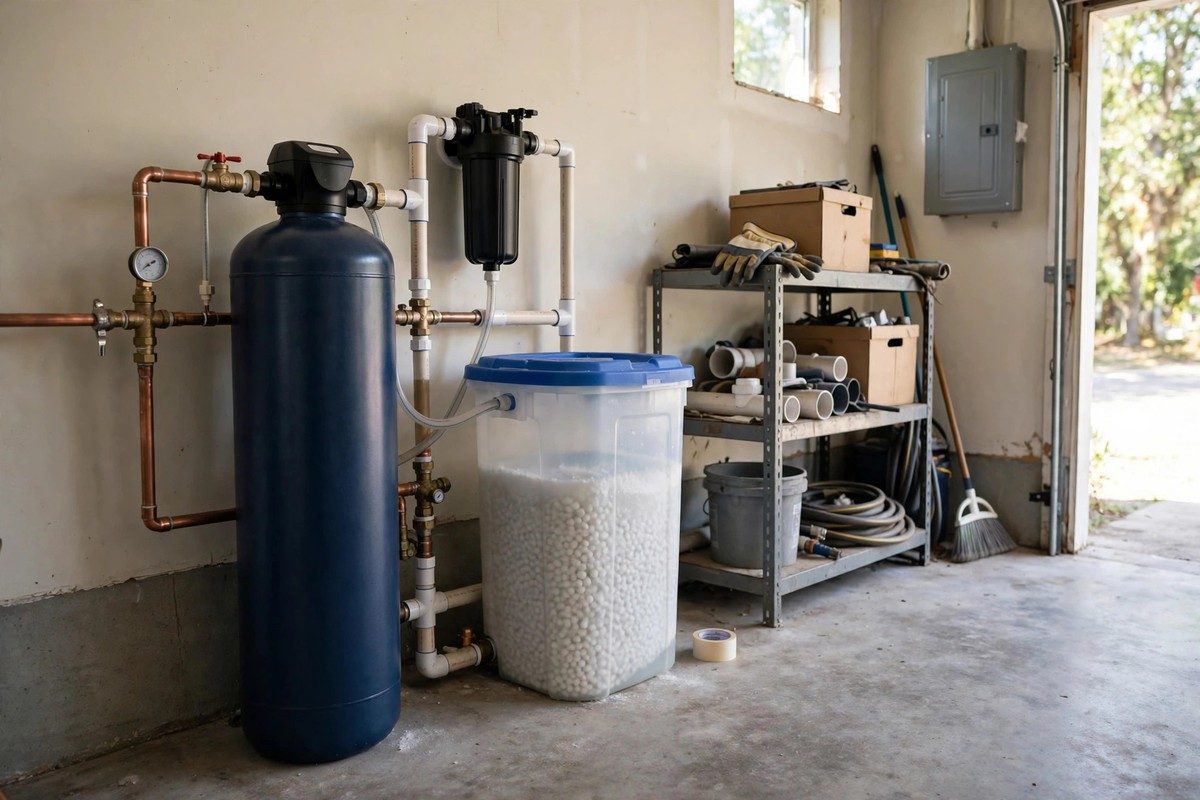
A water softener installed at the main line addresses hardness for the entire house, protecting every downstream fixture and appliance at once. Systems are sized to your household's water usage and the measured hardness level, not a generic default, which is why a water test matters before installation.
Softener Vs. Filtration: Not The Same Thing
It's worth being clear that a softener and a whole-home filtration system solve different problems. A softener targets hardness minerals specifically. Filtration targets taste, odor, chlorine, and sediment. Some households benefit from both working together, but conflating the two often leads to buying the wrong system for the actual complaint.
What Happens If You Never Address It
Hard water doesn't cause sudden failures on its own. It causes gradual wear that shortens the effective lifespan of everything it touches. Where hardness is high, a water heater rated for a decade can need replacement in six or seven years, and the same pattern repeats across dishwashers and washing machines.
What We Know About Water Supplies Around West Palm Beach
The City of West Palm Beach draws its water from Lake Mangonia and Clear Lake, which are fed by the Grassy Waters Preserve. Its plant uses lime softening, which lowers hardness, along with conventional filtration and ultraviolet and chloramine disinfection.
The city also buys finished water from the Palm Beach County system, and neighboring cities and unincorporated areas are served by other utilities. The city's annual water quality reports we reviewed do not list a hardness figure, so the only reliable number for your house is a test at your own tap.
If the reading comes back low, a softener may not earn its cost, and water filtration or routine heater flushing could do more for you. If it comes back high, a softener sized to your household protects the water heater and appliances downstream.
Getting An Actual Number Before Deciding
Rather than relying on general statements about the region's water, a direct test of your tap gives you an actual hardness reading in grains per gallon. That turns the softener decision from an impression into a concrete comparison against your fixture wear and water heater history.
Reading Your Test Result
Test results usually come back in grains per gallon or in milligrams per liter as calcium carbonate. The U.S. Geological Survey's general guidelines call water soft up to 60 mg/L, moderately hard from 61 to 120, hard from 121 to 180, and very hard above 180. Those are rough bands rather than rules, but they give you a way to place your own number.
A reading in the soft or moderately hard range rarely justifies a softener on its own. A reading in the hard or very hard range, combined with visible scale on your fixtures, is where a softener starts to pay off. Take the sample from a kitchen tap that has not been routed through existing treatment, and ask for a repeat test if the result surprises you.
What Ongoing Ownership Actually Looks Like
Once a softener is installed, ongoing upkeep is modest. Expect periodic salt refills in the brine tank on a schedule tied to your household's water usage. An occasional check of the resin bed and control valve confirms the system is still regenerating properly. Compared to the alternative of replacing water heaters and appliances earlier than necessary, this level of upkeep is a reasonable trade for most households once they've seen the actual hardness numbers for their own water.
The Bottom Line
Mineral content isn't a flaw in your house, and the fixture wear and spotting you notice aren't something you're doing wrong. The question worth answering isn't whether water in general is hard, it's how hard yours is, and whether the cost of a softener is justified by what you're seeing at home.
Tired of scale buildup or wondering if a softener is worth it for your house? We can test your water and give you a straight answer.
Frequently Asked
No. Hardness minerals aren't a health concern. The issues are limited to fixture wear, appliance lifespan, and cosmetic effects like spotting and reduced soap lather.
A water hardness test gives you an actual number rather than a guess, and from there it's a straightforward comparison against the fixture and appliance wear you're already experiencing.
It significantly reduces it in most cases. Some households pair a softener with a rinse aid in the dishwasher for the best results on glassware, which shows water spotting more visibly than plates or bowls.
A basic test can often be done on the spot during a visit, giving you an actual grains-per-gallon reading before you decide whether a softener makes sense for your household.
The city treats its supply with lime softening, but hardness at your tap depends on your address and utility. A simple test gives you a real grains-per-gallon number, and that number should drive the softener decision.
Related Services
A softener and a filtration system solve different problems, and water filtration installation is the right page if taste or odor is the actual complaint rather than hardness. Since hard water shortens water heater life, pairing this with regular water heater service protects that investment too. We also serve homeowners in Royal Palm Beach and Greenacres.